 Internal · Do not share
How to sell the co-design
The conversation guide that pairs with the product brochure and the design partner offer: the pitch, the demo order, the objections with counters that have worked in real calls, the ROI math for defending €50K, the design-partner qualification funnel, and the deal mechanics. Source: the Prudential architect call (June 2026) and the founding team's deal notes.
Lead with process intelligence, never with agents. If you open with "AI agents," you get compared to every automation platform on the market. Open with the ontology and the cockpit — "here is what we understand about your company" — and let the prospect pull you toward automation. This is exactly how the Prudential call turned: the excitement started when the intelligence layer came on screen, not before.
#01 The pitch in 30 seconds
Position: we are the intelligence layer that tells an enterprise where AI can actually be applied. Not an RPA vendor, not a consulting study, not a mining tool that needs a year of connectors.
Language discipline
- Say process discovery or process intelligence. Avoid "process mining" as a self-description — mining means reading system logs (Celonis territory), and it drags the conversation into a comparison we don't want. Use "mining" only to describe what they already have.
- Agents are the execution layer, mentioned after the intelligence story, never before it.
#02 The demo playbook
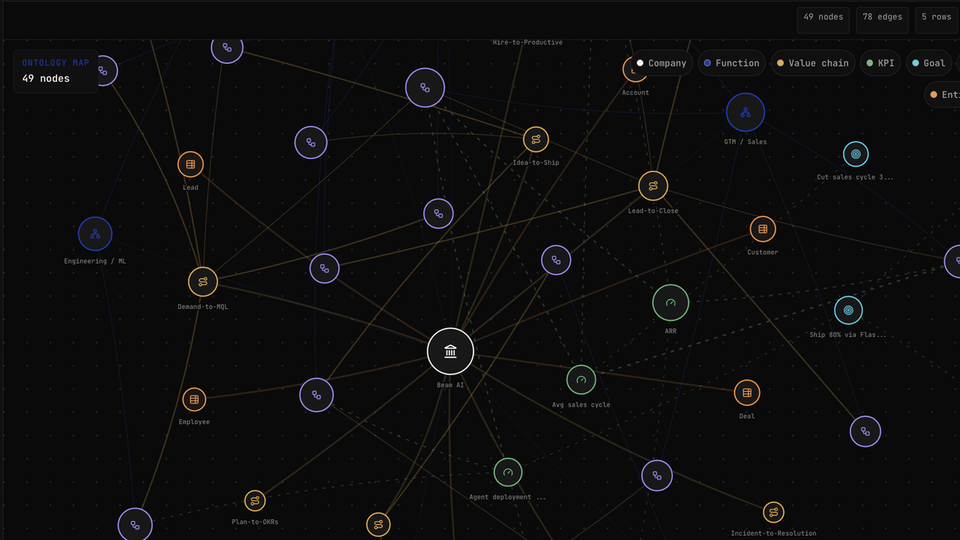
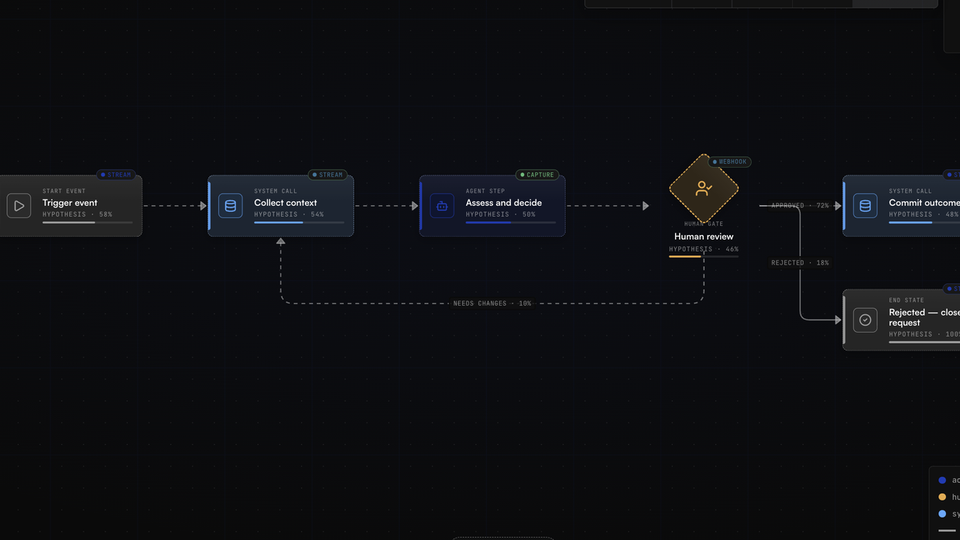
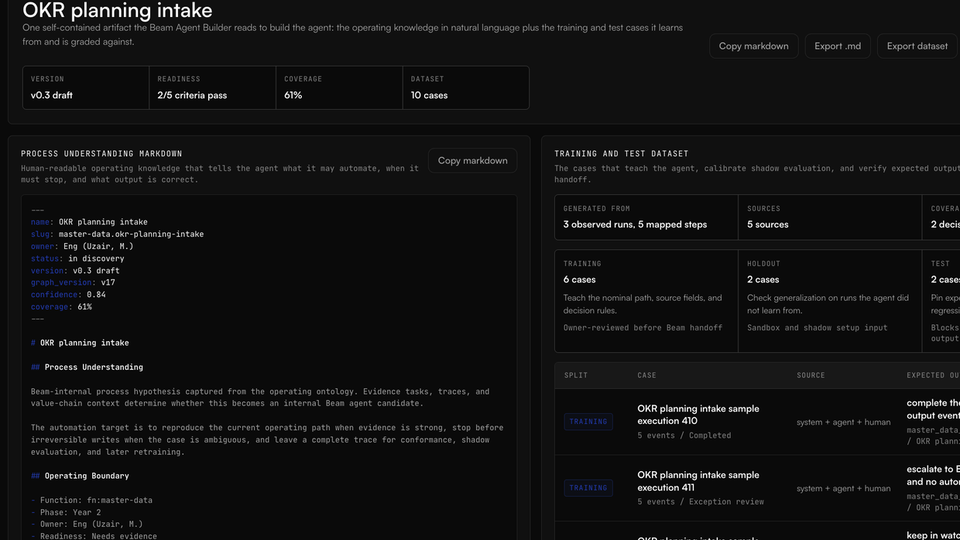
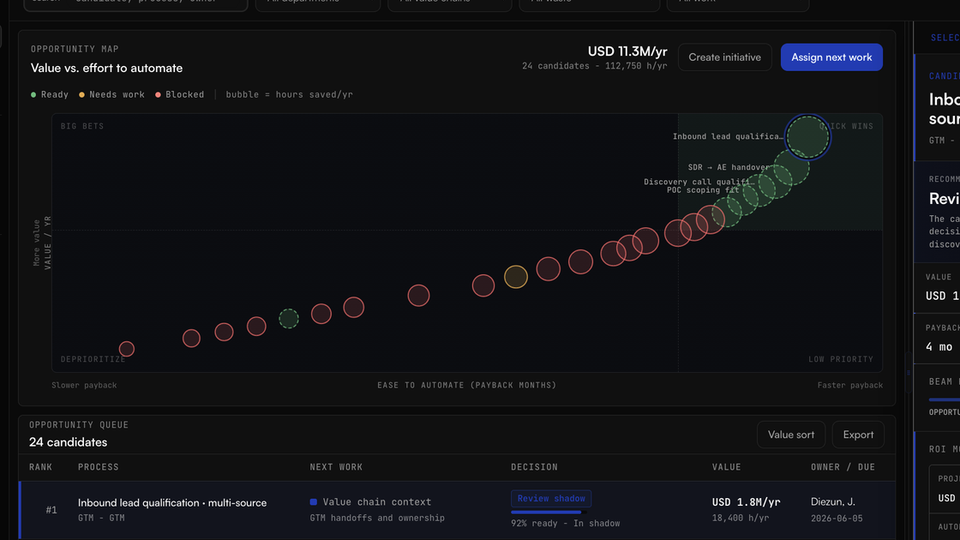
Demo link: process-mining-demo.pages.dev. Four screens, in this order. Show, pause, let them react — the Prudential call worked because we "did not frame much, just opened the prototype and noticed what was most exciting to him."
#03 Objections and counters
The first two happened verbatim in the Prudential call — and the counters below are what actually turned them.
- Don't argue with the comparison — redirect the frame: UiPath overlays AI onto an automation construct. We are the intelligence layer above all of that: we tell you where AI is worth applying at all.
- His words after the reframe: "That story is much more interesting than where you started." Use the ontology screen to make the difference visible instead of verbal.
- Agree — and reposition: that investment isn't wasted. Mining shows what systems log; it misses everything that happens between systems and in people's heads.
- We are the discovery and context layer that feeds it: their mining data can flow into our cockpit and finally become automation decisions. The Prudential architect's own point: existing mining tools "are not really built for integration with agents."
- Mining tells you a claim sat open for 50 days. We tell you why — the manual back-and-forth — and what automating it is worth.
- The fee buys outcomes, not access: ten processes with ROI analysis, three deep maps, one automation running live. That alone replaces a consulting engagement that costs more and delivers a PDF.
- Comparable process-intelligence platforms sell to enterprises at six-figure annual contracts. €50K fixed, with the product shaped around you, is the partner deal — and it ends when the product is finished.
- Skin in the game keeps both sides serious: paying partners get prioritised, and their feedback carries weight on the roadmap.
- Default setup: data is processed via enterprise AI APIs under DPAs — and access controls mean employees and the AI only see what the mapped process needs. Sensitive fields stay hidden.
- For sensitive environments there is a private deployment option — process data stays on infrastructure they approve.
- Then hand over, don't improvise: "Send me your security checklist and you'll have written answers." Loop in the team for sub-processor lists and certifications.
- The partner price and roadmap influence exist only now. Later they buy a finished product, at full price, shaped by someone else's processes.
- Waiting costs the savings too: every quarter their top processes run unmapped is measurable money (use the ROI math below on their example).
- Total ask: three process owners × one hour a week, a 30-minute check-in, one leadership session. Under four hours of company time weekly.
- Compare against the alternative: workshop-based documentation projects consume entire teams for months and go stale immediately.
#04 Battlecards
The three names you will actually hear in deals. Never open by attacking them — acknowledge what they are good at, then place us on a different layer. Wedges are v1: validated at positioning level, sharpen them with what you hear live.
 Log-based process mining
 Klarity
Closest direct competitor
Klarity
Closest direct competitor
 Accenture, Big 4, boutiques
#05 ROI math for defending €50K
Anchor on their numbers, not ours. The pattern from the Prudential call: pick one process they know is slow, quantify the delay, price the delay.
The architect's phrasing, reusable: "If we can reduce it by ten or even twenty days, that has real cash value to the business." The €10M figure is illustrative — always swap in the prospect's own volume. Cash-freed estimate = receivables × (days saved ÷ 365).
Three anchors to price against
| Alternative the prospect knows | What it costs them |
|---|---|
| Process-intelligence platforms (enterprise contracts) | Six figures per year, before integration effort |
| Consulting-led process documentation | More than €50K for a static report that ages immediately |
| Doing nothing | Their top-10 processes keep leaking hours — the cockpit quantifies it per process in the first weeks |
#06 Who to sell to, and who blocks
| Person in the room | What lights them up | Lead with |
|---|---|---|
| CIO / Chief Architect | The ontology. "I have not seen anything like this" came from exactly this persona. | Screen 1, plain-English queries, no-integration entry |
| COO / Transformation lead | The ranked automation queue — finally a fact base for where to start. | Screen 4, the 10-process ROI overview deliverable |
| CFO | Payback. Cash examples, fixed price, no open-ended consulting meter. | The receivables math, €50K fixed |
| Process owners | Being heard. Their workarounds finally documented — and a product that adapts to their feedback weekly. | The interview experience: one hour a week, their words |
Known blockers
- IT security / data protection — engage early with the security answers from #03; in Germany, ask whether a works council needs to be informed about employee interviews and observation. Raise it before they do — it builds trust.
- Middle managers guarding team time — the executive sponsor must mandate the ~4 hours weekly; if the sponsor won't, that's a qualification red flag, not a negotiation point.
#07 Qualification: the design-partner funnel
Every prospect runs through the same funnel, and "not a design partner" is a routing decision, not a rejection. Source: Strategic Development Partner Evaluation Framework (Chris Fennell, 3 July 2026), adapted for sales use.
The four gates (pass or stop)
Yes/no. One "no" stops the design-partner conversation — no score rescues a failed gate.
| Gate | Pass looks like | Disqualify |
|---|---|---|
| G1 · Executive mandate & vision | CEO/founder personally says "go do it," sees the vision, will champion it | Middle-manager pet project, no exec air cover — "a side project with no weight" |
| G2 · Leadership stability & capital | Stable C-suite, budget set aside, understands this is a 1yr+ journey | Restructuring, "headless," no committed budget, likely to defund midway |
| G3 · Mutual commitment & capacity | Their sponsor and our team both have the in-room bandwidth, sized and agreed upfront | Open-ended "we'll find time" — on either side |
| G4 · Expected output & reason to do it | A clear productionised output they walk away with, and a payoff big enough to endure for | Vague deliverable, "legibility" that doesn't move their business |
Discovery-call questions, mapped to gates
| What surfaces it on a call | Probes | Pass signal in the answer |
|---|---|---|
| "Who owns this decision — and have they personally said go?" | G1 | A named CEO/C-level champion, already engaged |
| "Is there budget set aside, and is leadership stable enough for a year-plus journey?" | G2 | Committed budget, no restructuring underway |
| "Can three process owners give an hour a week, with a sponsor protecting that time?" | G3 | Yes, without friction — the capacity is real |
| "What would you need to walk away with for this to be a clear win?" | G4 | A concrete output and payoff in their words, not ours |
| "How documented are these processes today? Where does the data live?" | T2/T3 | Honest answer either way — it sets the technical score, not the verdict |
| "Have you built with AI agents before? Who would work with us on your side?" | T1/T5 | Named engineers or AI team, some agent experience |
Scope guidance for the first build
Scoring the survivors — the full partner scorecard
For prospects that clear all four gates. Two lenses, equal weight, and a candidate must be credible on both: a strong brand with weak engineering fails, and strong engineering with no exec mandate fails. The weights are directional, not precise — the framework is untested against real deals, so log every scored candidate so they can be tuned against outcomes.
| Strategic lens · 50% | 5 — green flag | 1 — red flag | Wt |
|---|---|---|---|
| S1 · Access / network effect | Large network, bench or platform we gain access to | Closed; no leverage beyond the single deal | 12% |
| S2 · Industry-coverage fit | Opens a new, wanted vertical; ontology reusable across it | Duplicates a covered vertical, or one nobody values | 12% |
| S3 · Partner upside (their 10x) | Clear, large payoff — enough to invest and endure | "What's in it for them?" unclear | 12% |
| S4 · Brand value (risk-adjusted) | Reputable, brand-safe name that opens doors | Reputational risk, or so big they'd build it themselves | 8% |
| S5 · Ambition & altitude | Visibly ambitious, AI-native mindset | Distracted, reactive, low-altitude | 6% |
| Technical lens · 50% | 5 — green flag | 1 — red flag | Wt |
|---|---|---|---|
| T1 · Engineering bench on-hand | Process, API and AI engineers ready and willing now | No internal capacity — we'd staff it ourselves | 14% |
| T2 · Process documentation maturity | SOPs and process maps documented, ready to upload | Undocumented tribal knowledge only | 10% |
| T3 · Data legibility & modern stack | Consolidated data; been through a digital transformation | Siloed data, legacy walled-garden ERP | 10% |
| T4 · Open, API-first, composable | API-first, event-driven, leadership driving open systems | Closed architecture, no APIs | 10% |
| T5 · Agentic maturity | 6-12mo+ of agent builds, internal AI specialists | Zero agent experience | 6% |
Brand note from the source framework: while the concept is young, brand is upside, not a gate — keep partnerships quiet until proven, and don't over-weight a logo.
Risk modifiers (no points, quiet deductions)
| Modifier | Prefer | Penalise / flag |
|---|---|---|
| R1 · Size of the elephant | Mid/small org or one bounded department — small ontology, fast proof | Mega-enterprise scale → a 5-year map even with the best people |
| R2 · Compliance burden | Low regulatory drag — map and record freely | Heavily regulated (betting, banking) — mapping and recording get blocked |
| R3 · IP / vendor risk | Won't compete with us; strong contractual IP protection | Consultancy/vendor likely to copy the IP and resell it |
| R4 · Digital-first bias check | Verify the assumption | Don't auto-assume only digital-first brands are "legible" |
Per-candidate scorecard template
Candidate: ______________________

GATES     G1 exec mandate ...... PASS / FAIL
          G2 stability ......... PASS / FAIL
          G3 mutual commitment . PASS / FAIL
          G4 output & reason ... PASS / FAIL   → any FAIL: stop, route to sell-to

STRATEGIC (50%)                    score 1-5 × weight
  S1 Access / network .......... [ ] ×0.12   S4 Brand (risk-adj) .. [ ] ×0.08
  S2 Industry-coverage fit ..... [ ] ×0.12   S5 Ambition .......... [ ] ×0.06
  S3 Partner upside ............ [ ] ×0.12

TECHNICAL (50%)
  T1 Engineering bench ......... [ ] ×0.14   T4 Open / API-first .. [ ] ×0.10
  T2 Process docs / SOPs ....... [ ] ×0.10   T5 Agentic maturity .. [ ] ×0.06
  T3 Data legibility ........... [ ] ×0.10

RISK      R1 size [ ]  R2 compliance [ ]  R3 IP/vendor [ ]  R4 bias [ ]

VERDICT:  ⬤ Build partner   ◐ Maybe / conditional   ○ Sell-to only
#08 Deal mechanics
| Stage | What happens |
|---|---|
| 1 · Discovery call (30 min) | Their pain, one messy process, and the four gates from #07: exec mandate, stability & budget, real capacity, a concrete output they want. One "no" → route to the sell-to pipeline, not the co-design offer. Show screens 1 and 4 only if asked. |
| 2 · Live demo (45–60 min) | The four-screen playbook from #02, with their stakeholders in the room. |
| 3 · Scoping session | Select the ten candidate processes together, name the three process owners, start the security checklist. |
| 4 · Kickoff | Within ~2 weeks of signing. Interviews start week one. |
What we need from the client to start
- An executive sponsor with the mandate to allocate the time
- Three named process owners (one per deep-mapped process)
- Security/procurement contact and their checklist
- Agreement on the ten candidate processes (we co-select in scoping)
Negotiation guardrails
- €50K is fixed. Do not discount. If a prospect pushes, the flexible levers are payment terms and which processes make the ten — never the price. Anything beyond that, escalate to Aqib.
- The 8-week schedule in the offer doc is the default. Stretching to fit their calendar is fine; compressing below 8 weeks is not — the interviews need the weeks.
- Never quote rollout pricing. The line that works: "the engagement is €50K fixed; the rollout is something we design together in the week-8 readout."
- Everything they keep is already in the offer doc (maps, runbooks, ROI overview) — don't add commitments beyond it, especially not fee credits toward a rollout.
#09 Proof points
From a June 2026 call with the Chief Software Architect of a Fortune 500 insurer. Pending clearance — confirm with Aqib before quoting externally; safe to paraphrase in conversation.
Additional signal usable in conversation (not as a quote): a major North American insurer validated the core problem to us directly — they do not understand their own processes well enough to deploy AI confidently.
#10 Open gaps in this playbook
| Gap | Owner / status |
|---|---|
| Rollout pricing + payment terms | Aqib — define before first design partner signs |
| 8-week schedule + "everything stays yours" ownership stance | Aqib — drafted as working assumptions in the offer doc, confirm or correct |
| Quote clearance for external use | Aqib — currently paraphrase-only |
| Security certifications & sub-processor list as a sendable one-pager | Open — reps currently promise "written answers" without an artifact |
| Battlecard wedges (#04) at feature level | v1 shipped for Celonis, Klarity, consultancies — validate in live deals, especially the Klarity agent-building counter |